Kalligram Publishing is one of the most renowned workshops of Hungarian literature and book publishing. Its authors and contributors include prominent representatives of contemporary Hungarian and Central European intellectual life. Alongside fiction, works on literary history, social and historical sciences, and philosophy-aesthetics play an increasingly significant role in the publisher's repertoire.
In addition to publications on history, philosophy, and social history, the database offers works by classical authors from the medieval and early modern periods. The service includes nearly 300 volumes from Attraktor Publishing.
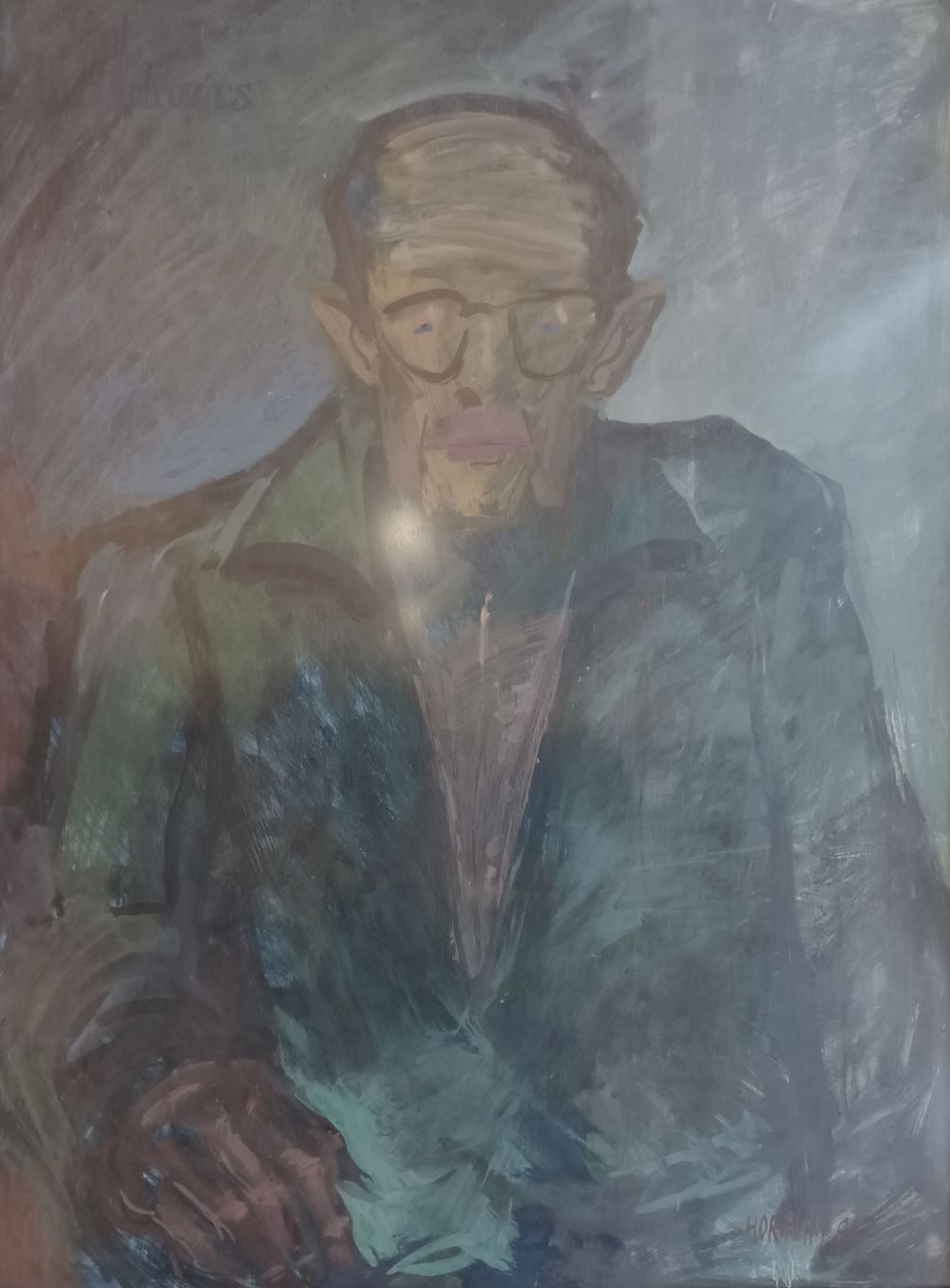
The ELTE EKL Savaria Library and Archives has been enriched with two new pictures. Professor László Hadrovics' painting complements the linguist's library legacy. A photographic reproduction of Ágoston Pável from 1911 has been placed in the memorial room of the poet, linguist and ethnographer.
The library collection of linguist László Hadrovics (1910–1997) has been supplemented with a painting depicting the professor, who began his professional career at the University Library in Budapest. The Hadrovics collection is accompanied with a painting by the college’s former lecturer, artist János Horváth.
The photograph of Ágoston Pável (1886–1946) was taken in 1911. A reproduction of the portrait has been placed in the memorial room of the linguist, poet and ethnographer. From 1924 until his death, Ágoston Pável worked as the custodian of the Szombathely Museum Library. Through his work, the books were categorized and the collection was continuously expanded, laying the foundation for the later independent library in Szombathely. Further details about his work are available on the website of the institution now known as the Berzsenyi Dániel Library.
Both works are on display on the second floor of the ELTE EKL Savaria Library and Archives.
The Faculty Library of the Gusztáv Bárczi Faculty of Special Education at ELTE is launching a four-part series of discussions on the social status of women.
Within the framework of the series, participants will discuss the social situation of women, the challenges faced by women with disabilities, the invisible barriers to academic careers, and the emergence of women politics in Hungary.
Eötvös Loránd University Library and Archives (ELTE Egyetemi Könyvtár és Levéltár) is offering an online training (via Microsoft Teams) entitled “Research Data Management and Data Management Plan Preparation”.
The presentation will cover the proper management of research data as well as the preparation of the research data management plan required for NKFIH NKKP grant applications. The aim is to familiarize participants with the concept and types of research data and the possible methods of generating them. The session will also address research data management more broadly and introduce tools that support research data storage, such as data repositories.
Please note: the presentation will be held in Hungarian.
Dates and times:
12 February 2026, 10:00–11:00
12 February 2026, 16:00–17:00
17 February 2026, 10:00–11:00
17 February 2026, 16:00–17:00
You can register for each session via this online form. The content of the sessions is identical.
The link to join the event will be sent in advance to the email address provided at registration. If you have any questions about the programme, please contact us at: oa@lib.elte.hu.
At the age of 72, Éva Farkas Szmrekovszkyné, a former prominent expert at the library of the college in Szombathely, passed away on 18 January 2026.
Éva Szmrekovszkyné Farkas was born on February 9, 1954, in Szombathely. From a young age, her career was defined by her love of learning, her service to the community, and her commitment to passing on knowledge. After graduating from Savaria High School, she studied library science and mathematics at the Szombathely Teacher Training College, where her pedagogical skills, reliability, and enthusiasm for library work became apparent during her children's library and school library internships.
A defining period in her life began in 1980, when she started her professional career as a periodicals librarian and information librarian at the college library. Éva quickly became one of the key figures in the library: thanks to her logical thinking, her degree in mathematics, and her exceptional systematic approach, she participated in the selection and implementation of the library's computer system and performed the duties of a systems librarian. In doing so, she played a pioneering role in the development of modern information services—at a time when many people were sitting in front of a computer for the first time in a library.
She was one of the first to master and teach the ISIS database management system; she created her own databases, including those for recording theses, college publications, and faculty publications. Through her work, she took information services and accurate and efficient information retrieval to a new level for students and faculty. He also initiated the use of the PRESSDOK and MANCI databases, which quickly made the library's services popular.
He played a significant role in the introduction of compulsory teaching of literature and library skills at our institution in Szombathely, one of the first in the country. The development of the course and its teaching over many years became a prominent part of his work. Later, he also played an active role in the introduction of online teaching platforms. His dedication was such that even as a premium-year pensioner, he returned to teach, help, and stay in touch with students and colleagues.
She represented the library in international competitions and study trips, from Brussels to Finland, and consistently sought to translate the experience she gained there into domestic practice. Her openness, professional standards, and commitment to continuous self-education served as an example to everyone.
Éva always combined her professional knowledge with humanity. Her quiet, thoughtful, and kind personality defined our community. Her colleagues respected her for her knowledge, and her students loved her for her patience and clear, supportive explanations. The library was not just a workplace for her, but a second home – and for us, she was one of the pillars of our community.
Her passing is a great loss, but her work, example, and humanity will remain within the walls of the library, in the knowledge of the generations she taught, and in the memories of all who knew her.
We cherish his memory with respect and affection.
ELTE EKL Savaria Library and Archives
In the framework of the ELTE–NFI FILMIO University Film Club's screening and discussion series, we commemorate the outstanding film director who passed away in January 2026.
The first film by 22-year-old Béla Tarr is a contemporary document, a sociological report, and a brutally honest exploration of petty human relationships. The actors are amateurs who play characters close to their own real-life situations. The dramatic authenticity is guaranteed by the super-close-up, handheld camera shots with direct sound (i.e., recorded on location). Tarr is not interested in the social and public implications of the housing problem typical of the era, but rather in the development of human relationships and the interaction of emotions and passions revealed in seemingly hopeless situations. In The Family Nest, the housing shortage is not a temporary condition, but an unchangeable hell.
Young Irén lives with seven other people in her father-in-law's one-bedroom apartment, which lacks basic amenities. Due to the forced confinement, conflicts are a daily occurrence, and the situation does not improve even when her husband, Laci, returns home after completing his military service. They still do not have the money to move out, and Irén's weekly visits to the office are in vain, as no one there can offer her any encouragement. Her father-in-law constantly stirs up tension, accusing her of infidelity, and slowly her marriage begins to fall apart.
The film won the Grand Prize at the Mannheim Film Festival, as well as the Hungarian Film Critics' Award, and was recognised in the categories of Best First Film and Best Cinematography.
Date: 20 February 2026, 6:00 p.m.
Venue: University Square Campus (1053 Budapest, Egyetem tér 1–3., Weiss Emilia Hall, ground floor, in the corridor next to the cloakroom)
Director, screenwriter: Béla Tarr
Cinematographer: Ferenc Pap
Editor: Anna Kornis
Music: Szabolcs Szörényi, László Tolcsvay, Mihály Móricz
Cast: Mrs. László Horváth, László Horváth, Gábor Kun, Mrs. Gábor Kun, Gábor Kun Jr., Irén Rácz
Our guests in the post-screening discussion will be Andrea Pass, playwright and director, who created a stage version of the film in 2020, and Márkus Keller, PhD, associate professor and head of the Department of Comparative Historical Sociology at ELTE's Faculty of Social Sciences.
The documentary shows the first year and a half of recovery for two young people with substance abuse issues. We get to know them through the activities of the Megálló Group Foundation in Budapest. The Megálló Group Foundation’s recreation center for people with addictions is run by former addicts who use innovative methods such as rock climbing for therapeutic purposes. Szilveszter and Boróka embark on the rocky road of self-discovery, confronting their stormy relationships with their parents while seeking support, forgiveness, and above all, self-acceptance. The film had its world premiere at the 40th Warsaw International Film Festival in 2024, where the jury gave special recognition to the film’s human approach and deep empathy. In Hungary, it was first screened at the Verzio International Human Rights Documentary Film Festival, then released in theaters on 5 December 2024.
Date: 18 February 2026, 6:00 p.m.
Venue: ELTE University Library and Archives, community space (1053 Budapest, Ferenciek tere 6.)
Director, cinematographer, editor: Ádám Miklós
Music: Andor Sperling
Our guests in the post-screening discussion will be Ádám Miklós, director of the film, Péter Oláh, chairman of the board of trustees of the Megálló Group, and Dénes Dudits, addiction specialist.
This free-spirited Romeo and Juliet parody, peppered with catchy rap songs, is a unique animated ghetto film set in Józsefváros. Filled with social commentary and references to current political events, this adult satire is made in the outspoken, provocative tone of American shows like South Park and Beavis and Butt-head, giving a humorous and authentic view of the twisted political and social order of post-millennial Eastern Europe from the perspective of kids who call a spade a spade – from a bottom-up perspective.
The love between two young Roma people is hindered by conflict between their parents. Ricsi wants to use money to settle the dispute between the families. He and his friends travel back to prehistoric times in a time machine, where, with the help of their Stone Age ancestors, they hunt mammoths in the hope that the animal carcasses will form a huge oil field under the 8th district over the millennia, making them rich overnight. Rambo DVD box sets, five-star school cafeterias, gold Rolex watches on all their wrists. The sudden appearance of vast amounts of oil causes turmoil in the global economy, and the superpowers launch an investigation, closing in on the ghetto, but one thing is certain: Nyócker will remain Nyócker for as long as the world exists.
Date: February 11, 2026, 6:00 p.m.
Venue: University Square Campus (1053 Budapest, Egyetem tér 1-3., Weiss Emilia Hall, ground floor, in the corridor next to the cloakroom)
Cast list:
Director: Áron Gauder
Screenplay: Viktor Nagy, László Jakab Orsós, Damage
Design: Áron Gauder, Igor Bóka
Composer: Zsolt Hammer, Ádám Jávorka, Viktor László, Alex Hunyadi, Spacecafe
Music: Ludditák, L.L. Junior
Cast/voice actors: László Szacsvay, Győző Szabó, Csaba Pinndroch, L.L. Junior, Gábor Csőre, Dorka Gryllus, Károly Gesztesi, Sándor Badár
Our guests in the post-screening discussion: Áron Gauder, director of the film, lecturer at Budapest Metropolitan University, and Ildikó Szili-Darók, supervisor, drawing analyst, organizational developer, mental health and family counselor, drama group leader, former head of the Józsefváros Family Support Service and expert on Józsefváros.